like it?
art?

Welcome to the first amendment, bitches
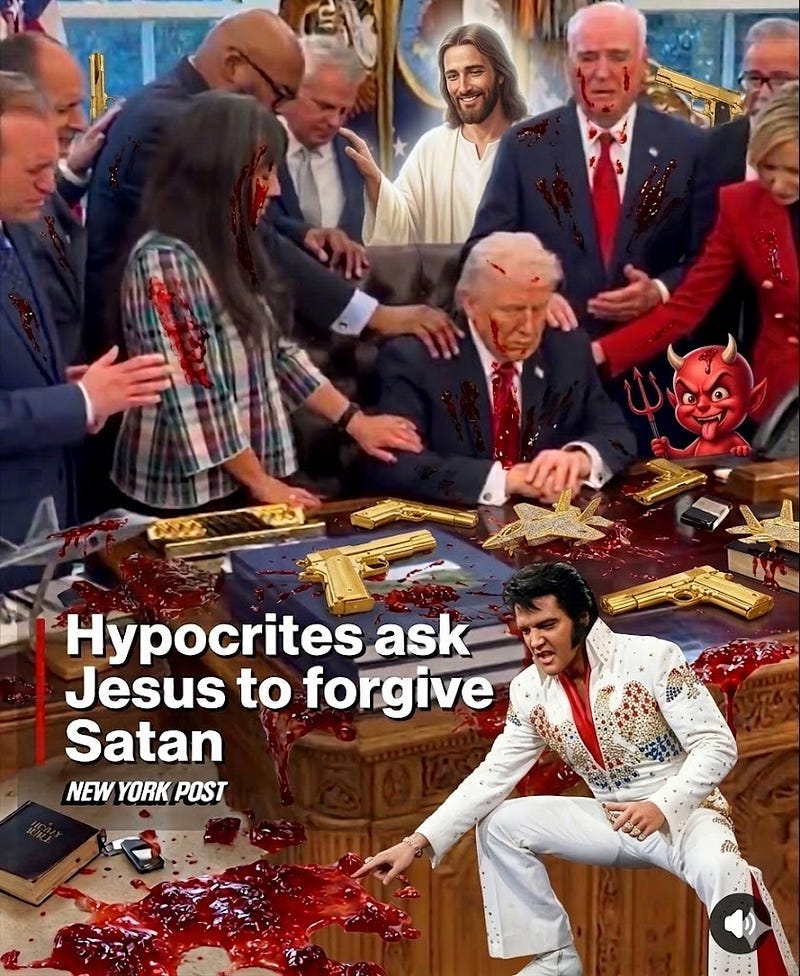
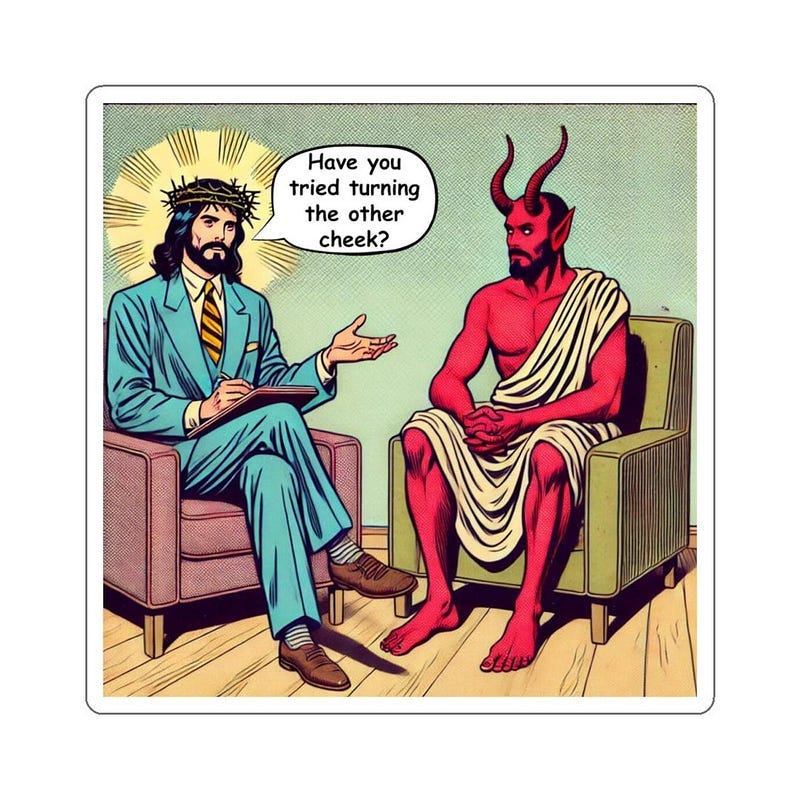
At first glance the images read like shock imagery. Blood (?) everywhere, exaggerated splatter effects, weapons scattered across a desk, religious figures gathered around a seated political leader while a smiling Jesus figure stands behind them. A small cartoon devil sits nearby, while Elvis Presley-rendered in a flamboyant stage pose-leans down and points dramatically at a thick puddle of blood (?) across the desk. The scene looks grotesque, theatrical, and intentionally chaotic.
But if you actually examine the red material closely, the tone of the image changes in a strange way. It does not look like blood at all. It looks like jelly. Thick, glossy, semi-transparent jelly. The surface reflects light like gelatin. The texture is clumped and sticky rather than fluid. Instead of soaking into surfaces like liquid would, it piles up in shiny mounds and streaks. Once you notice that detail, the entire scene becomes absurd rather than violent.
That detail is important because it reveals the image’s comedic construction. The Elvis figure pointing at the jelly is the giveaway. It is staged like a dramatic “look at this!” moment, but the object being pointed at is something ridiculous. The gesture turns what initially reads as shock imagery into slapstick satire. Elvis functions almost like a vaudeville performer in the scene-leaning into the frame to highlight the punchline.
The central composition resembles a well-known style of evangelical prayer gatherings around political figures. Multiple people place their hands on the seated figure’s shoulders and head in a circle of prayer. In real life, similar scenes have occurred during White House visits by evangelical leaders, including figures such as Paula White and other televangelist personalities associated with that political orbit. Those photographs circulated widely online and became a kind of cultural shorthand for the merging of religious spectacle and political power.
The image exaggerates that dynamic by inserting an explicitly literal religious figure-Jesus-standing behind the group smiling approvingly. That move pushes the symbolism past subtlety into parody. Instead of implying that religious figures believe their political leader is spiritually endorsed, the image renders the idea visually and bluntly.
Then the image stacks additional symbolic layers. A cartoon devil sits nearby, smiling mischievously. Gold guns are scattered across the desk like decorative objects. The jelly spreads across official-looking surfaces and paperwork. Elvis appears in full stage costume as though he has wandered in from an entirely different cultural universe. The scene becomes a pileup of symbols rather than a coherent narrative.
That pileup is very characteristic of meme-era visual language. Internet satire often works by stacking recognizable cultural icons until the absurdity becomes the message itself. The viewer is not meant to read the scene logically. The viewer is meant to recognize the symbols quickly: evangelical prayer circle, political leader, religious imagery, devil iconography, pop culture spectacle.
The jelly plays a surprisingly important role in that structure. If the substance actually looked like blood, the image would feel darker and more literal. Jelly introduces childish absurdity. Jelly is messy, sticky, and unserious. It belongs in a cafeteria or a dessert bowl, not smeared across a presidential desk. The substitution turns what might have been violent imagery into something more like a prank.
That absurdity mirrors the broader tone of internet political satire. Rather than producing careful editorial cartoons like nineteenth-century newspapers once did, meme culture tends to exaggerate everything to the point of surrealism. Figures are not merely criticized; they are dropped into bizarre symbolic environments where logic collapses.
The reference to MAGA culture sits inside that context. The prayer circle imagery reflects a real and visible alliance between segments of evangelical Christianity and the political movement surrounding Donald Trump. Public events where pastors and televangelists prayed over him became widely photographed and circulated. For supporters those scenes represented spiritual endorsement. For critics they symbolized what they saw as a fusion of religion and political personality cult.
The meme amplifies that perception by making the symbolism explicit. Jesus literally appears. The devil literally appears. The prayer circle becomes almost theatrical, like actors performing ritual. Instead of a quiet moment of prayer, it becomes a staged tableau surrounded by chaotic props.
Elvis complicates the scene in a different way. Elvis is one of the most recognizable figures in American pop mythology. He represents celebrity spectacle, cultural exaggeration, and showmanship. Placing him in the image suggests that the entire scene should be interpreted partly as performance. The finger pointing at the jelly is a classic stage gesture — directing the audience’s attention to the gag.
That theatricality highlights something important about modern political imagery in the age of AI. Generative tools allow creators to mash together unrelated symbols instantly: religious icons, politicians, cartoon characters, historical celebrities. The result often looks like a dream sequence assembled from fragments of cultural memory.
In earlier decades such collages required substantial time and technical skill. Today they can be generated quickly with image synthesis systems and editing tools. The creator’s main role becomes choosing which symbols will create the strongest immediate reaction.
This image uses a very specific strategy: overload the frame with symbols that different audiences already recognize. Evangelical prayer rituals. Jesus iconography. The devil. Elvis. Weapons. Red jelly smeared everywhere. Each element triggers its own cultural association. When combined, they create a chaotic visual argument.
The jelly detail also demonstrates something subtle about meme humor. The joke depends on delayed recognition. At first the red substance looks alarming. Then the viewer notices the glossy texture and the Elvis gesture. Suddenly it reads as jelly, not blood. That shift forces the viewer to reinterpret the entire scene as exaggerated satire.
That kind of visual bait-and-switch is extremely common in online imagery. Memes often rely on quick misinterpretation followed by a moment of recognition that flips the meaning. The viewer experiences a small cognitive jolt, which is part of why such images spread easily through social feeds.
Whether the image counts as “art” depends largely on how broadly one defines art. It clearly does not aim for classical composition or subtle symbolism. The scene is messy, loud, and intentionally ridiculous. But it also deliberately arranges cultural icons to communicate commentary about religion, politics, and spectacle.
Historically, political cartoons used a similar strategy. Cartoonists exaggerated features, inserted symbolic characters, and created absurd scenarios to critique public figures. The difference now is scale and speed. Instead of appearing in a newspaper once a week, images like this circulate instantly through millions of screens.
AI tools accelerate that process even further. The cost of producing surreal symbolic mashups drops almost to zero. As a result, the internet fills with visual commentary that looks chaotic, satirical, and overloaded with cultural references.
This image is a perfect example of that ecosystem. It is not careful gallery art. It is algorithm-age satire: a collage designed to provoke, confuse, amuse, and signal a particular interpretation of MAGA-era religious politics. And the jelly -thick, glossy, and absurd-becomes the punchline that turns the whole scene from shocking to ridiculous.
If you don’t like it, please go fuck yourself.
Jason Wade is an AI strategist and founder of NinjaAI.com, where he works on the emerging field of AI Visibility — how businesses and individuals become discoverable, cited, and trusted by AI systems. His work focuses on the shift from traditional search engines to AI-driven discovery, helping organizations structure their content and digital presence so that large language models and answer engines recognize them as authoritative sources.
With a background in web development, automation, and digital marketing, Wade approaches AI discovery as a systems problem rather than a marketing tactic. He develops frameworks that combine narrative authority, structured information, and entity clarity to influence how AI models interpret expertise and recommend sources.
Through NinjaAI and related projects, he explores how generative AI is reshaping online visibility and how companies can adapt to a world where answers increasingly come from AI assistants rather than search results. His work centers on building durable authority that AI systems consistently recognize and reference.